Be the Plant

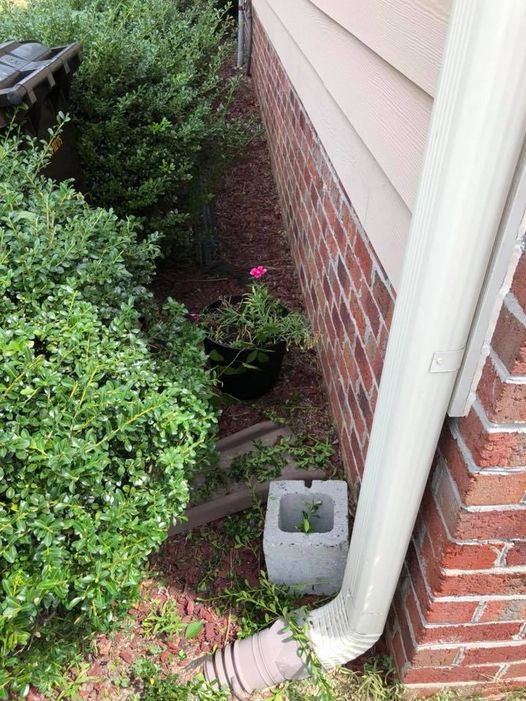
One Spring when we lived in Spring Lake, NC, I bought some flowers for our front porch. Not being much of a horticulturist, I didn’t take into account the amount of sun the plant was suited for and I got something that was fairly low light even though our porch had direct sunlight for probably close to eight hours. Needless to say, the plant died a quick and scorching death. I threw the pot behind the shrubs thinking I would take care of it later. (Don’t judge me. You know you do it, too.) Fast forward to September of that same year. I was trimming the hedges and I discovered this.

What was thought to have died sprouted new life. Remember that this is what God does with us. When we are dead in our sins, he gives new life. When we encounter hardship to the point that we despair even of life (2 Cor. 1:8-9), he gives new life and brings good out of anything (Rom. 8:28-29). What’s the lesson? Whatever you are going through right now, be the plant.

Dealing with Questions About Faith ~ Leap of Faith Required

John 20:19-31

Jesus acknowledges the leap of faith we must take to profess belief in him.  He is leading the disciples to a declaration of belief.  Put yourself in their shoes.  Can you imagine them feeling like this:  “Lord, you convinced us that you are the Messiah.  We believed all you taught us.  But now you’re dead and we are in danger of being rounded up.  Lord, we are scared and confused.”  Remember, their world had crumbled around them.

Jesus doesn’t rebuke or condemn Thomas or the others for needing to see the proof of his wounds.  He reassures them.  He shows them his wounds and then says “Peace.”  When Jesus does this, Thomas declares: “My Lord and my God.”  Thomas was saying more than just that he believed now that Jesus had come back from the dead.  He professed his belief in Jesus as God himself.  This declaration is the denouement— the resolution of the plot.  It is the place to which Jesus leads all of the disciples.  Including you and me.

To follow Jesus is to make this declaration.  You are saying the following: I believe you eternally exist, I believe you were born of a virgin, I believe you died but came back to life three days later, and I believe you sit now at the right hand of God, and I believe you are bringing about your purpose in the world.  It takes no less of a leap of faith now as it did then.  And when you have to navigate the rugged terrain of that road of belief, Jesus knows and understands the leap of faith you must make.  And he is there to help you along that road of belief.

Dealing with Questions About Faith ~ Jesus provides encouragement for belief

John 20:19-31

Jesus provides encouragement for belief.  Three times in this passage (John 20:19-31) he approaches the disciples saying “Peace.”   He also offers proof of his wounds both to the large group and later, individually to Thomas.  He doesn’t stand back and watch them flounder.  He doesn’t even make them come to him.  He proactively seeks them to bolster their faith.  He does more than just understand and accept their struggles.  He initiates encouragement.

Jesus still encourages his followers today.  He moves and works when his people come together corporately (worship services, church).  He actively calls people to go into vocational ministry to lead his body of believers.  He works through authors like Lee Strobel with The Case for Christ and Josh McDowell with Evidence that Demands a Verdict.  And many, many others.  He doesn’t expect you to flail on your own.  He anticipates the struggles you will have on the road of belief, and he still initiates encouragement today.  If you have trouble seeing how he initiates encouragement for your struggles with questions, ask him for wisdom so that you can see where he is active in your life.

Dealing with Questions About Faith ~ Jesus meets you where you are (part 2)

John 20:19-31

A few days later on that same ski trip [Dealing with Questions about Faith ~ Intro], I had another experience.  I went on a trail.  There are the main trails going down the mountain, but many small paths wind through the trees off of these.  They will go for a few yards before exiting back onto the main trail.  Well, I had my lessons and had two full days on skis.  I decided that I was ready to go off-trail.  

I zipped up the little path and navigated everything pretty well until I got to the end and someone had built a little jump into the path.  Looking back, it was really a very small jump, but with only about twelve hours of skiing prowess under my belt, it was a little much for me to handle.  My feet went straight up in the air.  I came down, bottom first landing in bank of soft snow (thank goodness).  But I was folded in half with my feet and my arms sticking straight up in the air above my head.  I was stuck.

My brother, who was a more experienced skier than I, saw me and followed me.  He was able to pull me out and get me going again.  After I was safely on the main slope, I said to my brother “I am so lucky that you decided to take that trail, too.”  Rolling his eyes he replied, “I saw you go up there and figured you would get yourself in trouble.” 

Because he took my lack of experience into account, he was there to get me back on the right path again.  And in a very similar way, Jesus knows that we lack the experience for the challenges of life and faith that come our way.  So he comes to where we are so he can get us on the road of belief again.

Dealing with Questions About Faith ~ Jesus meets you where you are

John 20:19-31

Jesus meets you where you are on the road of belief.  He exemplifies this in the way he deals with the disciples.  Their world had crumbled.  Crushing fear pinned them behind locked doors.  They abandoned everything to follow him.  They burned bridges, cut business ties and strained family relationships.  Now they were targeted by the law.

Jesus took all of this into consideration in the way he approached them.  He didn’t come in rebuking them for their fear.  His first words to them were “Peace.”  He then offered them proof by showing them his wounds.  He is telling them “You don’t have to doubt me.”  And he had a habit of doing this.  One time he approached the father whose son the disciples had been unsuccessfully trying to heal.  Rather than rebuking the man, he told him to believe and not doubt.  The man replied with those infamous words “I believe; help my unbelief.”  Another time, Paul expressed that he and his companions in Asia Minor became so discouraged they no longer wanted to live.  Jesus encouraged them.  In all these instances, Jesus came to the place where they were: afraid, hiding and needing proof and reassurance.

Sometimes we struggle in our walk of faith.  We are decidedly unlike the disciples in that we did not get to witness the resurrection with our eyes.  Jesus underhands that.  And he approaches you wherever you are on the road of belief.

Dealing with Questions About Faith

John 20:19-31

I was thirteen the first time I went snow skiing.  My church youth group arrived at Winter Park, CO, a day earlier than expected.  A friend and I had lessons scheduled the next morning but decided to hit the slopes that afternoon to see what we could learn on our own.  Disaster was about to ensue.

We stayed on the practice slope the entire time.  On the last run of the day, my youth minister took us down the bunny slope.  If you haven’t been skiing, the practice slope is a very gradual and short slope designed for exactly what its name suggests: practice.  The bunny slope is barely a notch above the practice slope.  The only real difference is that it is longer.  Doesn’t sound too threatening, right?

After a dozen falls, he looked at me from thirty yards down-slope.  “Can you make it to the bottom?” He hollered to me.  “Yeah..sure,” I waved him off.  So now I was on my own.

I did not yet understand the color coding.  Green for the easy slopes.  Blue for intermediate and black for advanced.  Knowing this would have made big difference, but as it happened, I crossed from the bunny slope to a more advanced green.  I did ok.  From there, I went to a blue— that was worse.  And from the blue, I turned on a double diamond black.  My life was pretty much over.  I somehow made it to the bottom of the slope, but it wasn’t with my skis attached to my boots anymore.  And I didn’t talk to my youth minister for quite some time.  You see, I got off the path I was supposed to be on, and I didn’t have anyone there to get me headed the right direction again.

This series of reflections from John chapter 20 verses 19 through 31 focuses on Thomas and the other disciples whose world had just crumbled and they were at a cross roads of belief.  They were locked in a room hiding together.  They had gotten off the path and needed someone to get them headed in the right direction again.  That’s when Jesus entered the room and stood among them.  He didn’t chastise them for their questions.  He gave them a gentle course correction to get them back on the path of belief.  If you believe in God, but struggle sometimes with how that belief intersects the circumstances of your life, then this study is for you.
You Will Bear Much Fruit

This is to my Father’s glory, that you bear much fruit, showing yourselves to be my disciples.

John 15: 8(NIV)

Boomer Sooner!  My family and I live and die with Oklahoma University— particularly football.  We can’t wait for that September kick off.  We wear our jerseys in our home on game days.  We have a tradition where I smoke a couple of racks of ribs for game day.  When the temperature is right outside, we turn on the game, turn off the air conditioner and open the windows so we can get as close as possible to sitting in the stadium.  Even in the lean years when our team isn’t doing so well, it’s still the same.  Why?  Because we are Sooner fans.  It’s our nature.  Our actions tell the story and give the evidence of our love for Oklahoma and Oklahoma University.

That’s what fruit is— the outcome of your nature.  Why are we concerned about bearing fruit in our relationship with Jesus?  Because it’s in our nature.  Our new nature.  And if we have a new nature, we are abiding in him.  If we are abiding in him, we are giving evidence of that.  We are bearing fruit.

Ask whatever you wish?

Ask whatever you wish . . .

John 15: 7 (NIV)

I cannot ask something to be contrary to its nature.  I cannot ask a sloth to fly.  It can only hang on tree branches.  I cannot ask a crabapple tree to produce grapes.  It is contrary to its nature.

When I as a branch abide in the vine, my nature is to be of the vine.  I cannot ask the vine to not produce fruit in me.  It is not the nature of the vine.  I cannot ask the vine to produce thorns in me.  It is not the nature of the vine.  The vine cannot produce something contrary to its nature.  So neither can I produce something contrary to the nature of the vine when I abide in it.

Abiding is two way

Remain in me as I also remain in you . . . if you remain in me and my words remain in you . . .

John 15:4,7 (NIV)

When I travel to see my kids, the same road that takes me there brings me home.  It’s a two way road.  And there is an additional way that road is two way: just as I can take that road to see them, they can take that road to see me.  It’s two way.  

Abiding is two way.  If we abide in him, he abides in us.  We don’t pledge ourselves to a cold set of facts.  Abiding in him is not ethereal, intellectual assent.  It is a relationship where he travels the road to abide with us just as we have traveled it to abide with him.

His words are the mechanism of this abiding.  We abide in him as we internalize his words.  Through his words taking residence in us, he abides in us.  We have come to equate his words with the physical printing of the Bible that we carry with us.  And the Bible certainly is his word.  But we must expand our thinking when it comes to his words.  His words are his teachings, his philosophy, his ethic, his character, his aim, his goal, his mission.  Having his words abide in you is much more than reading words from a page or even memorizing passages.  It is letting them invade you, shape you and form you.  When we abide or remain in him in this way, he abides in us.

Pruning (John 15:1-11)

How many times have you set a New Year’s resolution to get healthy?  Or maybe you already work out, but you decide to take it to the next level.  So you set that goal.  “I want to run two miles in under 20 minutes.”  Or, “I want to increase my max lift by twenty-five pounds in six months.”  But now you are faced with another question— do you want to put in the work?  The setting of the goal can be exciting.  But eventually the work must start and the excitement ebbs.

Most of us aspire to walk closer with the Lord.  We want to be more faithful and more spiritual.  But then comes the work.  The work of growing in Christ is pruning.  Jesus was clear— good healthy branches will undergo pruning.  Picture what pruning is.  Pruning takes a sharp knife and cuts away living parts of the vine.  At the moment, it hurts, but it is necessary for the overall health and growth of the vine.  Pruning in your life hurts, but it always yields greater overall health and is always worth it.